


Tarot cards have fascinated people for centuries, offering a mirror into our thoughts, choices, and the paths ahead. But if you’ve ever wondered how tarot cards actually work — whether it’s magic, psychology, or something in between — you’re not alone. In this guide, we’ll break down the mechanics behind tarot reading, the meaning of the cards, and how you can use tarot for guidance and self-reflection.
What Is Tarot, Exactly?
A tarot deck is a set of 78 cards divided into two main groups:
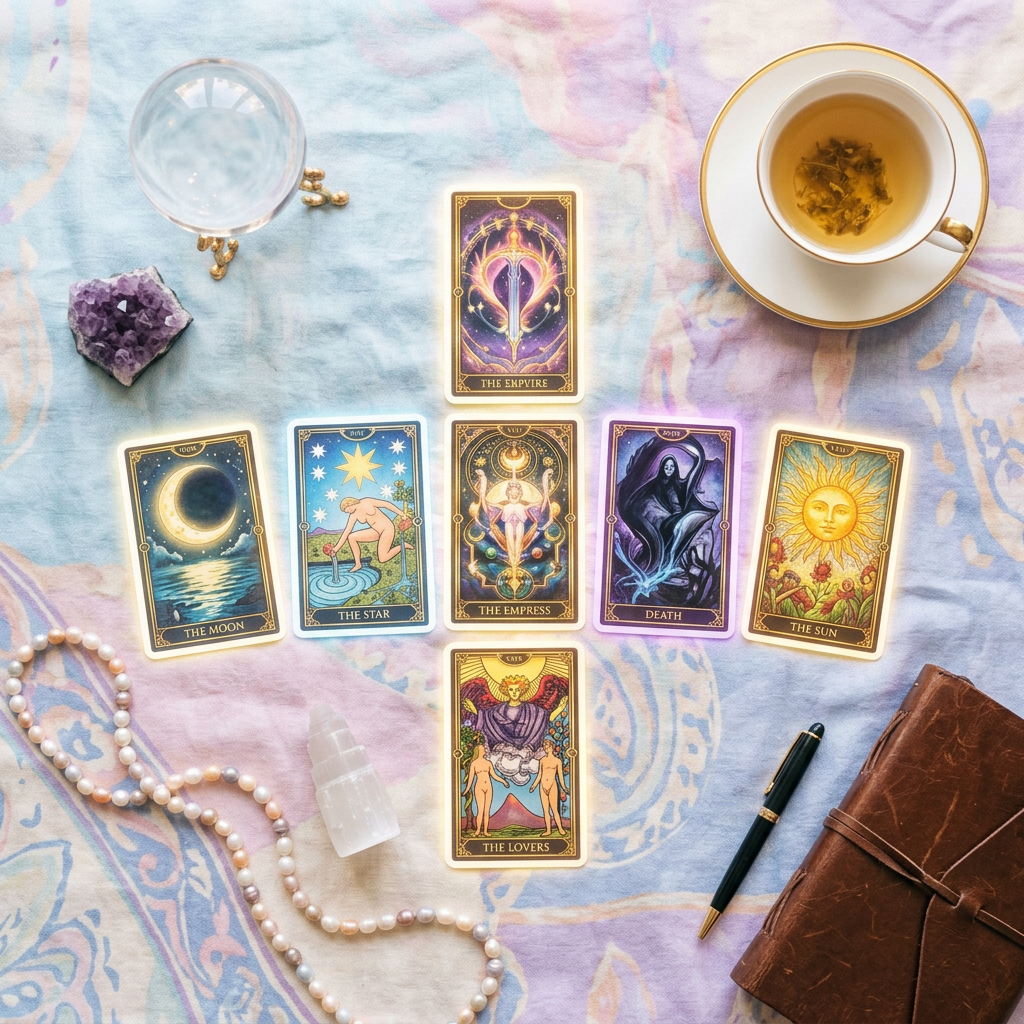
- The Major Arcana (22 cards) — These represent big life themes, spiritual lessons, and major turning points. Cards like The Fool, The Tower, and The Sun speak to universal human experiences.
- The Minor Arcana (56 cards) — Split into four suits (Cups, Wands, Swords, and Pentacles), these cards reflect everyday situations, emotions, challenges, and practical matters.
Each card carries its own symbolism, built up over hundreds of years of tradition, art, and interpretation.
So, How Do Tarot Cards Actually “Work”?
There isn’t one single explanation, and different people understand tarot in different ways. Here are the three most common perspectives:
1. Tarot as a Tool for Reflection
Many practitioners view tarot as a psychological tool rather than a fortune-telling device. The imagery and symbolism on each card act like a mirror, prompting you to reflect on your current situation from a new angle. When you pull a card, your mind naturally connects its imagery to what’s happening in your life — this is similar to how a good conversation with a wise friend can help you see things more clearly.
2. Tarot and Intuition
Some readers believe tarot works by tapping into intuition — a kind of inner knowing that gets activated when you focus your attention and ask a question. The cards act as a prompt, helping surface thoughts or feelings you may not have consciously acknowledged yet.
3. Tarot as Energy or Synchronicity
Others believe tarot connects to a larger, energetic pattern — the idea that the card you draw isn’t random, but meaningfully linked to your question at that moment. This is often described using the concept of synchronicity, a term coined by psychologist Carl Jung to describe meaningful coincidences.
Regardless of which explanation resonates with you, what matters most is the intention and openness you bring to a reading.
How a Tarot Reading Actually Happens
Here’s what typically happens during a tarot session:
- Setting an intention or question — You (or your reader) focus on a specific question or area of life you want clarity on — love, career, personal growth, etc.
- Shuffling the deck — The cards are shuffled, often while thinking about the question.
- Drawing cards into a spread — Cards are laid out in a specific pattern, called a “spread.” Common spreads include the 3-card (Past, Present, Future) spread and the more detailed Celtic Cross.
- Interpreting the cards — Each card’s meaning is considered both on its own and in relation to the cards around it, along with whether it appears upright or reversed (upside down).
- Weaving a narrative — A skilled tarot reader connects the individual card meanings into a coherent story or piece of guidance relevant to your question.
Do You Need Special Powers to Read Tarot?
Not at all. While some readers describe having strong intuitive gifts, tarot reading is a skill that can be learned by anyone willing to study the meanings of the cards and practice interpreting them. Many people start by reading for themselves, journaling their draws, and slowly building familiarity with the deck’s symbolism.
What Tarot Can — and Can’t — Tell You
Tarot is best used as a tool for reflection, guidance, and gaining a new perspective on a situation — not as a way to predict the future with certainty. Think of it as a conversation starter with yourself: the cards raise questions and possibilities, but you remain the one who makes decisions and takes action in your life.
Getting Started With Tarot
If you’re curious to explore tarot for yourself, here are a few simple steps:
- Choose a beginner-friendly deck, such as the Rider-Waite-Smith deck, which is one of the most widely used and well-documented.
- Start with simple spreads, like a single-card daily draw or a 3-card spread.
- Keep a journal of your readings to track patterns and deepen your understanding over time.
- Consider a professional reading if you’d like deeper insight or guidance navigating a specific life question.
Final Thoughts
Tarot cards work by combining rich symbolism, focused intention, and the reader’s ability to weave meaning between the cards and your life. Whether you see it as a psychological tool, an intuitive practice, or something more mystical, tarot offers a unique way to pause, reflect, and gain clarity on the questions that matter most to you.
If you’d like a personalized tarot reading to explore what the cards have to say about your journey, Durga Tarot is here to help guide you.
Frequently Asked Questions
Is tarot reading real?
Tarot reading is a practice of reflection and interpretation rather than a scientifically proven method of prediction. Many people find genuine value in it as a tool for self-exploration and decision-making.
Can I read tarot cards for myself?
Yes! Many people successfully read tarot for themselves. It just takes practice, patience, and an openness to what the cards reveal.
What’s the difference between upright and reversed cards?
An upright card generally reflects the card’s core meaning in a direct way, while a reversed (upside-down) card often suggests a blocked, delayed, or internalized version of that same energy.
How many cards are in a tarot deck?
A standard tarot deck has 78 cards: 22 Major Arcana cards and 56 Minor Arcana cards.